
A Data Fabric for Scalable, Controlled Data Movement
Most data problems are created before data is stored or analyzed.
A data fabric exists to solve this problem.
Ingext Data Fabric is a real-time control layer that collects, transforms, and routes data agnostically, ensuring that data arrives where it is needed, in the shape it is needed, without forcing downstream systems to compensate for poor ingestion decisions.
Rather than binding data to a single destination or purpose, a data fabric keeps data fluid, intentional, and reusable.
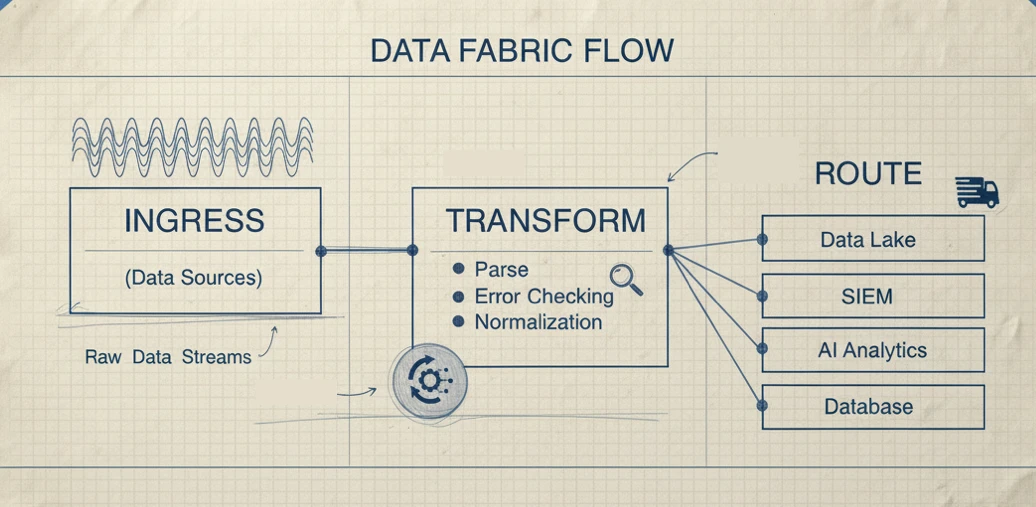
What a Data Fabric Does
A data fabric exists to make data intentional before it is stored or used.
Collect
Onboard sources once by handling protocol and authentication at ingress, keeping collection stable even as destinations change.
Transform
Correct structure, normalize values, and apply logic inline so data is shaped once and reused consistently everywhere it flows.
Route
Deliver data to multiple destinations based on purpose, in the form each system requires, without duplicating pipelines.
Ingext’s Data Fabric performs three functions — once, upstream, and independently of any downstream system.
These functions happen before storage, indexing, or analytics, where errors are expensive and difficult to undo.
By separating data movement from data usage, Ingext ensures downstream systems receive data that is already clean, consistent, and fit for purpose — allowing them to focus on analysis and computation, not correction.
Data First, Systems Second
Most platforms require data to conform to their internal models, binding ingestion logic to a specific system and locking decisions in early.
A data fabric reverses this relationship.
With Ingext, data is shaped once, intentionally, at ingestion — and then delivered to downstream systems without being rewritten to suit each one.
Analytics engines, AI pipelines, storage layers, and operational tools each receive data in the structure they expect, without duplicate pipelines, reprocessing, or corrective logic.
Reuse Without Rework
By separating data movement from data usage, Ingext keeps data fluid while systems remain replaceable.
New systems can be added. Old systems can be removed.
The way data is collected, shaped, and routed does not have to change.
This is what allows data to outlive the tools that consume it.
Lakehouses Focus on Lakes, Not Creation
Lakehouse platforms are built to query and analyze lakes — but lake creation is where most teams lose consistency and control.
Lakes, not clean creation
Most lakehouse platforms assume data already exists in a usable form.
They are designed to query and analyze data lakes, not to help you create them cleanly.
As a result:
- ingestion logic is fragmented
- transformation is deferred until after storage
- data lakes become dumping grounds instead of assets
Ingext Data Fabric changes this model.
By controlling collection, transformation, and routing upstream, Ingext makes lake creation a first-class responsibility — not an afterthought.
This is what makes Ingext a lakehouse designed to build a lake, not just query one.
Preparation Must Happen Before Analysis
Transformation is not just parsing.
In many lakehouse systems, analysts are forced to:
- create derived columns after storage
- recalculate fields repeatedly
- correct inconsistencies at query time
This approach is expensive, brittle, and incompatible with streaming data.
The lake becomes temporary, constantly reworked storage — costly to operate and impossible to keep consistent.
Continuous Transformation, Not Deferred Cleanup
Ingext applies transformation and calculation inline, as data flows.
Calculations, normalization, and corrections are performed once and continuously, ensuring:
- data is always in a usable state
- historical and real-time data remain consistent
- downstream analysis does not depend on fragile assumptions
The result is data that is ready when it arrives, not fixed later.